
Everyone knows Pompeii, and this archaeological park truly deserves its fame and attention. However, the eruption of Mount Vesuvius was a large-scale disaster, and other cities were destroyed as well. One of them was Herculaneum. During our trip to Naples, we visited it too.
The road to Herculaneum
The railway station of Herculaneum is closer to Naples than Pompeii, but reaching the archaeological park is more difficult. There are almost no signs, and the park itself is located quite far from the station.
Here, my wife’s knowledge of foreign languages helped us a lot. Although she teaches German and does not know Italian, even knowing one foreign language greatly improves communication skills. After talking to local residents, we finally found the archaeological park and began another journey through time.
A completely different experience
Naturally, like most travellers, we compared Herculaneum with Pompeii. And these are two completely different places. Pompeii is a full-scale ancient city. Herculaneum is a compact archaeological park. There are several reasons for this:
- The city itself was smaller than Pompeii.
- Excavations in Herculaneum are still ongoing, as a modern city stands above the ancient one.
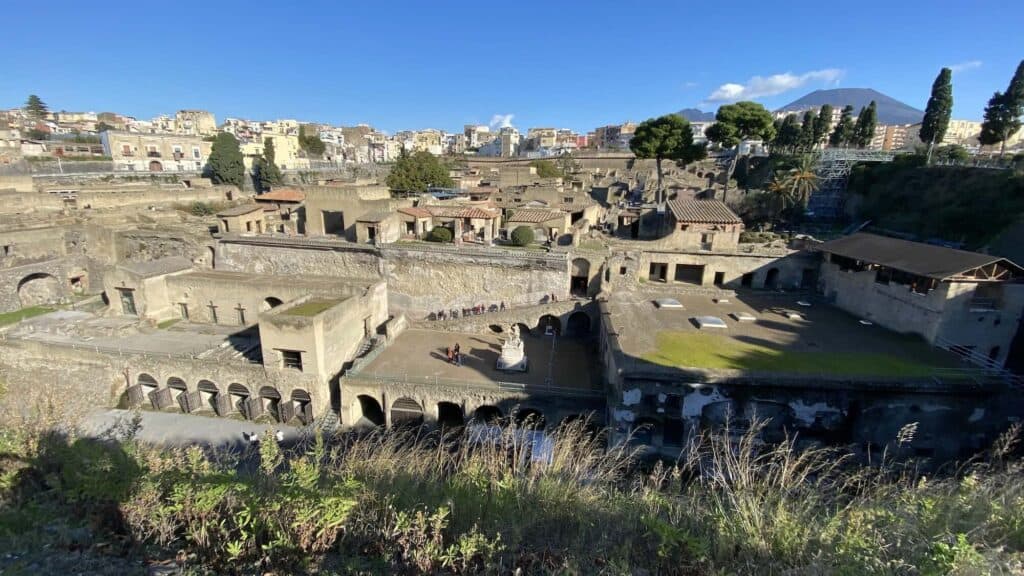
- The scale is limited to just a few blocks, which can be easily taken in at a glance.
Differences in everyday life are also noticeable. The central houses of Pompeii are richer in decoration and built on a larger scale than the buildings of Herculaneum. At the same time, the preservation of both cities is so good that such details are easy to see.
More modest does not mean worse
Despite these differences, Herculaneum is very interesting in its own way. Here, as in Pompeii, houses, streets, interiors, and everyday objects are well preserved. This is especially interesting to explore when compared to the larger and wealthier city of Pompeii.
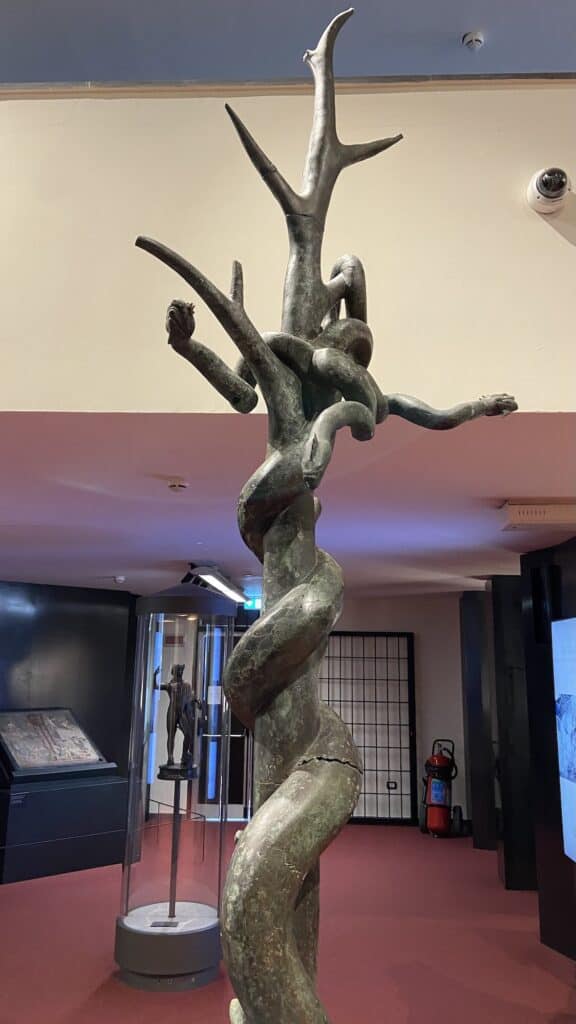
The archaeological park has a small museum with artifacts from the city and materials about the history of the excavations, as well as a bookshop where we bought books dedicated to Herculaneum. Everything is present, but on a different scale.
The interaction of antiquity and modern life
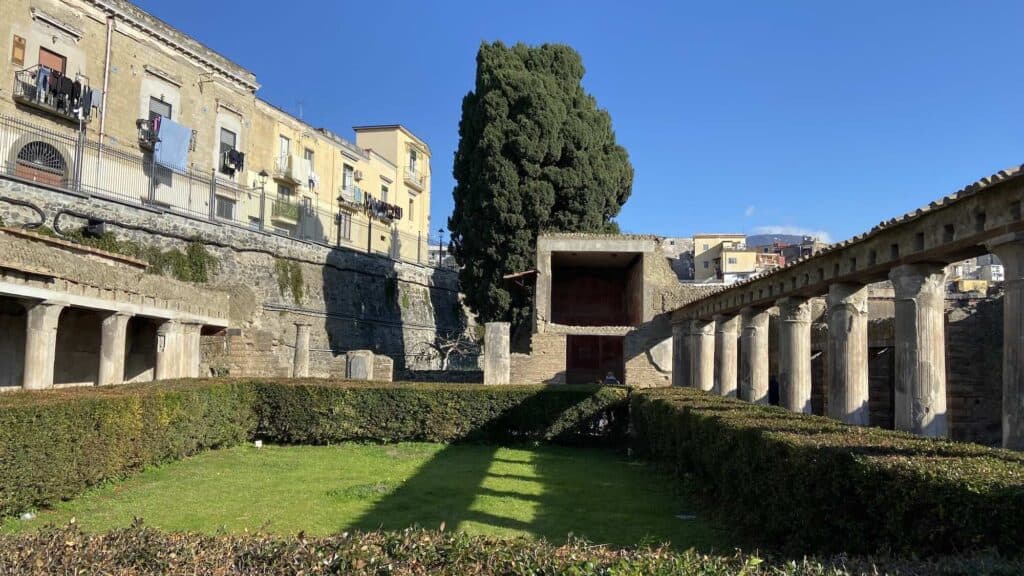
In Pompeii, the archaeological park is integrated into the modern city: you pass through a turnstile and suddenly find yourself in another time. In Herculaneum, this effect feels even stronger. The excavations end at a large structure, likely a temple. Tourists are not allowed to enter, but it is clear that archaeological work is still actively ongoing.
Directly above this structure stands the modern city. From the observation platform, the connection between eras is especially visible — the ancient city literally lies beneath the modern one.
Another journey through time
In Herculaneum, clear time boundaries seem to disappear. On one hand, the modern city is clearly visible from the observation platform. On the other, when you descend into the excavated quarters, you are fully immersed in antiquity.
It is another great way to step out of routine, change context, and reset before returning to work.