

We spent one of our winter holidays in Nuremberg. Unfortunately, we missed the Christmas market because our holiday started just one day after it closed. But although the main market was already over, there were still plenty of festive stalls selling all kinds of interesting things along the central streets.
And why do I call Nuremberg a city that makes sense? Because everything here is simple. Inside the old city walls is the historic center, which is worth exploring from end to end. Outside the walls are modern residential areas, which are probably less interesting for tourists. Near one of the gates to the old town is the railway station, where you can catch a train almost anywhere. We used it to visit Bamberg and Rothenburg ob der Tauber. Everything is simple and clear. Just as you would expect in Germany!
The Streets of Nuremberg
Our apartment was close to the old town. We would go outside and simply walk through its central streets. It’s a beautiful and interesting place. The Pegnitz River runs through the historic center, so there are plenty of bridges and interesting buildings along the water. On our first evening, we came across a small square not far from Nuremberg Castle.
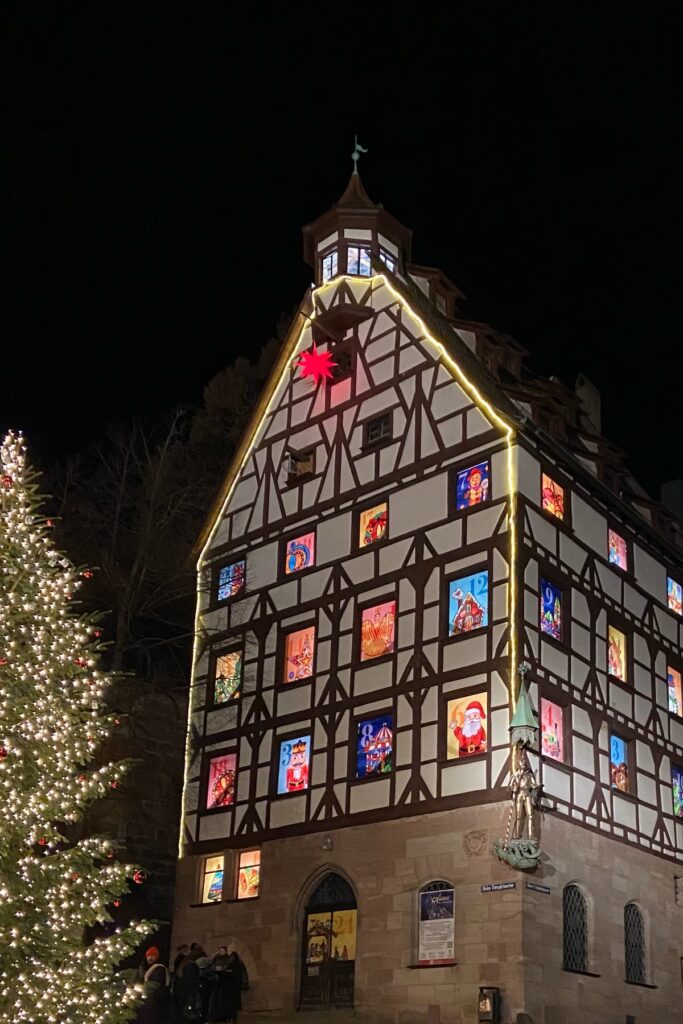
The main attraction on this square is Albrecht Dürer’s House. Dürer was a famous German painter and printmaker of the Northern Renaissance. His former home is now a museum, and it’s well worth visiting.
But what we remember most is a half-timbered house on the same square. Its windows were decorated like an Advent calendar, with each window representing a day in December. Winter, glowing windows, a decorated Christmas tree nearby. It was a lovely sight, and one that stayed in our memory.
Half-Timbered Houses
I had never seen so many half-timbered houses in one place before. To be fair, I had never been to Germany before either.
Nuremberg is home to one of Germany’s largest half-timbered buildings, the Weinstadel, or Wine Warehouse. It’s about 48 meters long and was built between 1446 and 1448. These dimensions might not seem impressive today, but it was a major construction project at the time.
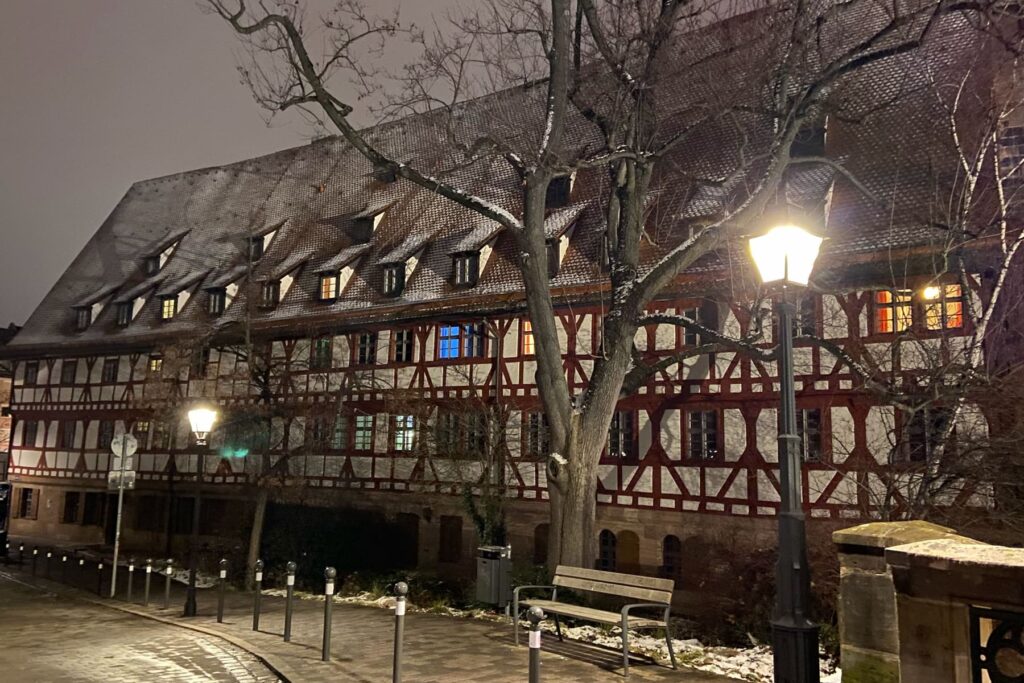
I always thought the wooden beams on half-timbered houses were just decoration. It turns out they are actually the main structure of the building. The spaces between the beams were filled with different building materials. One of the most traditional was a mixture of clay and straw.
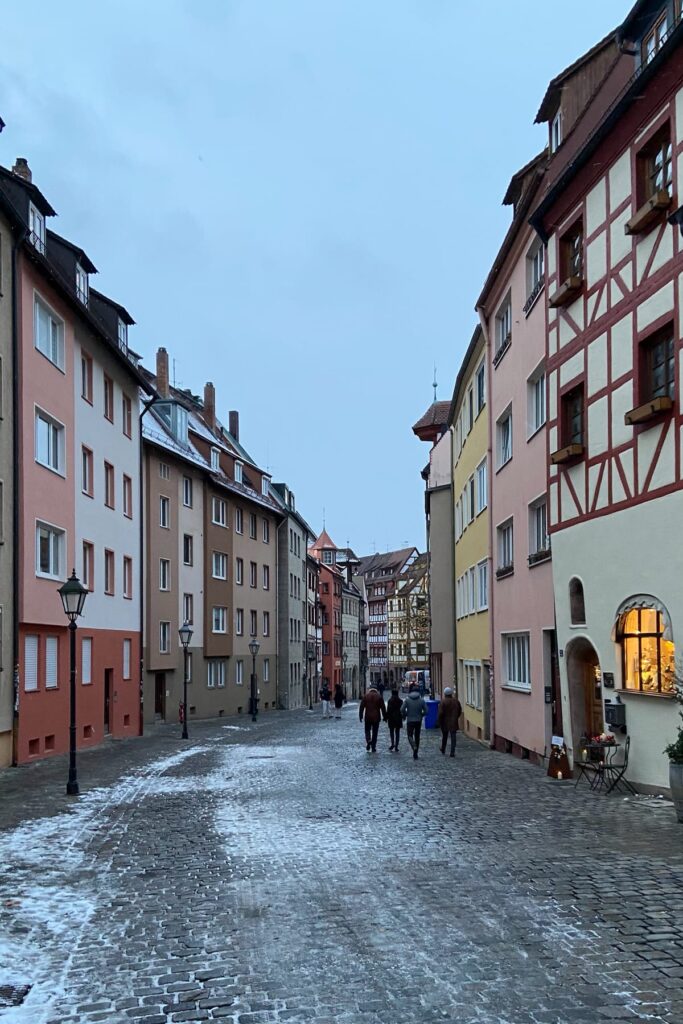
Nuremberg also has an entire street of medieval half-timbered houses called Weißgerbergasse. The name literally means “White Tanners’ Street.” Many historic buildings have survived here. On one of the houses, with golden-colored wooden beams, we found information panels explaining what half-timbered construction is, how these houses were built, and other details. Both the street and the buildings are beautiful. Definitely worth a visit.
Nuremberg Imperial Castle
It feels as if all the central streets eventually lead to Nuremberg Castle. It’s also known as the Imperial Castle because it really was one of the residences of the Holy Roman Emperors. They didn’t have one permanent residence. Instead, they traveled around their territories and often stayed in Nuremberg.
The castle is very interesting inside, with its architecture and historical exhibitions. I especially remember the deep well, which supplied the castle with water during sieges. There’s a separate part of the tour dedicated to it. They lower a camera into the well to show just how deep it is and how impressive such a structure was for its time.
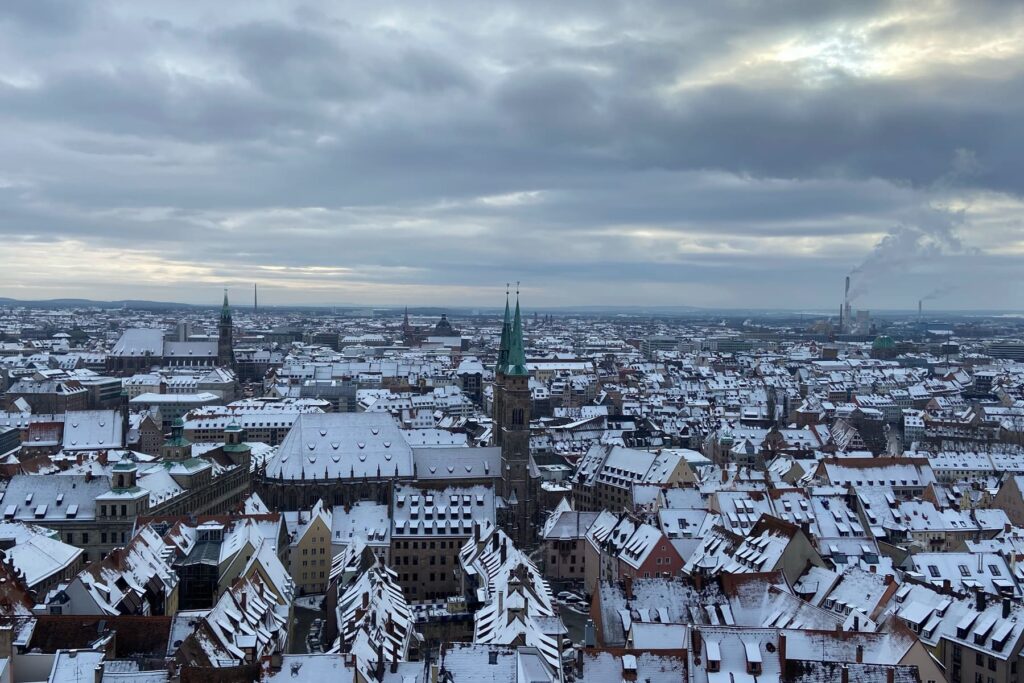
Another thing I remember about the castle is the view over Nuremberg. The castle stands on a hill, so you get a great view of the old town from above. It’s a perfect place for taking photos.
More About Nuremberg
Nuremberg is also connected to one of the darkest periods in German history. The Nazis held their huge party rallies here, and after the Second World War, the Nuremberg Trials took place in the city.
There are several museums dedicated to this period. The courthouse where the trials were held now has a museum exhibition. There’s also the Documentation Center Nazi Party Rally Grounds, not far from Zeppelinfeld, the enormous field where mass Nazi rallies took place. Apart from their historical importance, these places are also interesting because they are outside the old town. Visiting them gives you a chance to see another part of Nuremberg.
And of course, I can’t leave out Nuremberg’s red beer! Its distinctive color comes from the special malt used in brewing. And it tastes wonderful. I happen to love beer, but for health reasons I’m not really supposed to drink it often anymore. I made a very honest effort to control myself. But it was almost impossible! The beer was so good that I ended up enjoying this wonderful drink every single day.
A Memorable Trip
Our trip to Nuremberg left us with very good memories. There are plenty of things to see, places to walk around, and other towns to visit by train from the central station.
We spent two weeks there, and we probably could have seen all the main attractions much faster. But we weren’t in a hurry. We took our time and enjoyed the city, with German precision and practicality!